The Copper Peptide Glow Is Probably the Bakuchiol: A Side-by-Side With Two COSRX Products
The fast brightening effect people credit to copper peptides is most likely the bakuchiol sitting next to it in the bottle, because when I used two products with an identical disclosed 0.5% copper peptide dose and five times different bakuchiol, the quick glow showed up with the higher-bakuchiol one and not in the same way with the other.
The finding
If a copper peptide product made your skin look brighter within a couple of weeks, the copper peptide is probably not what did it. In my own use, the fast glow tracked the bakuchiol dose, not the copper peptide dose.
I am not asking you to take that on assertion. There is an unusually clean comparison available in this category, I happened to run both halves of it firsthand, and the result was consistent enough to be worth writing down. It is also not a controlled study, and I will be explicit about that further down rather than burying it.
Why this comparison is possible at all
Most copper peptide products make attribution impossible. They are combination formulas, brands rarely disclose concentrations, and you cannot tell which of six actives produced the thing you noticed.
COSRX accidentally set up something better. They sell two products in the same Blue Peptide Bakuchiol line, and both disclose their numbers:
- The serum: Copper Tripeptide-1 at 0.5% (5,000ppm), bakuchiol at 0.25%
- The cream: Copper Tripeptide-1 at 0.5% (5,000ppm), bakuchiol at 0.05%
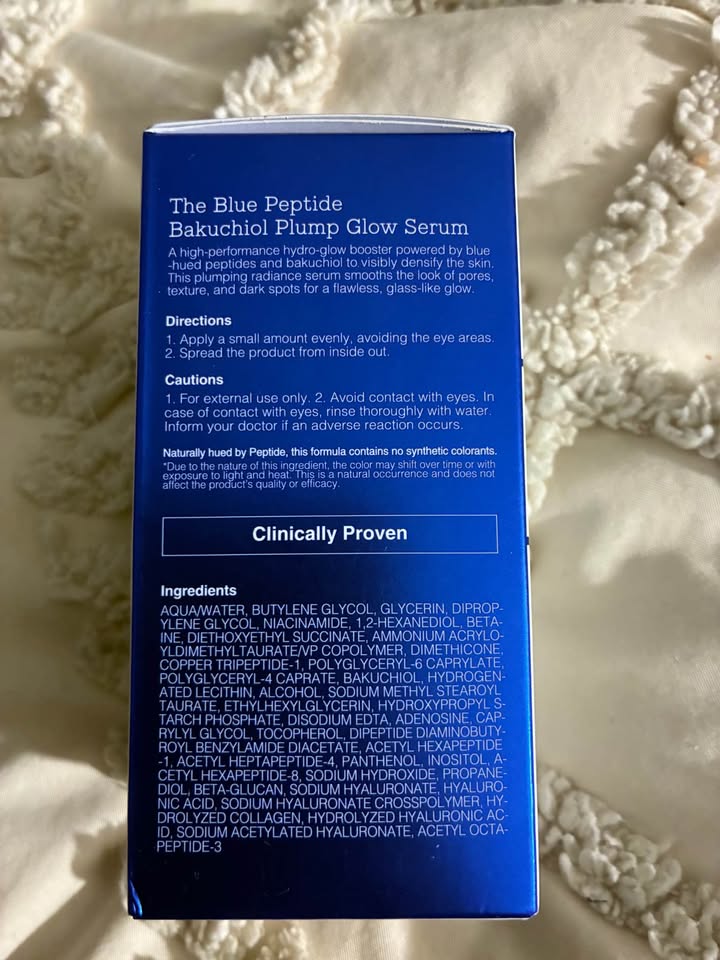
One honest complication before I lean on those numbers. On the serum’s own ingredient panel, photographed above, Copper Tripeptide-1 sits eleventh and bakuchiol fourteenth. A disclosed percentage and a mid-list INCI position are both true at once, and the second one is the part brands do not put on the front of the box. It does not change the comparison below, because both products disclose the same copper figure, but you should know it is a mid-list ingredient in both.
The copper peptide dose is held constant. The bakuchiol differs by a factor of five. That is close to the structure of an actual experiment, and it only exists because COSRX discloses per-active figures in a category built on vagueness, which is a point I make at length in what “1% copper peptides” actually means. You cannot run this comparison on brands that hide the numbers.
I used both. The serum twice daily for eight weeks, the cream twice daily for seven weeks as the final step over my serums.
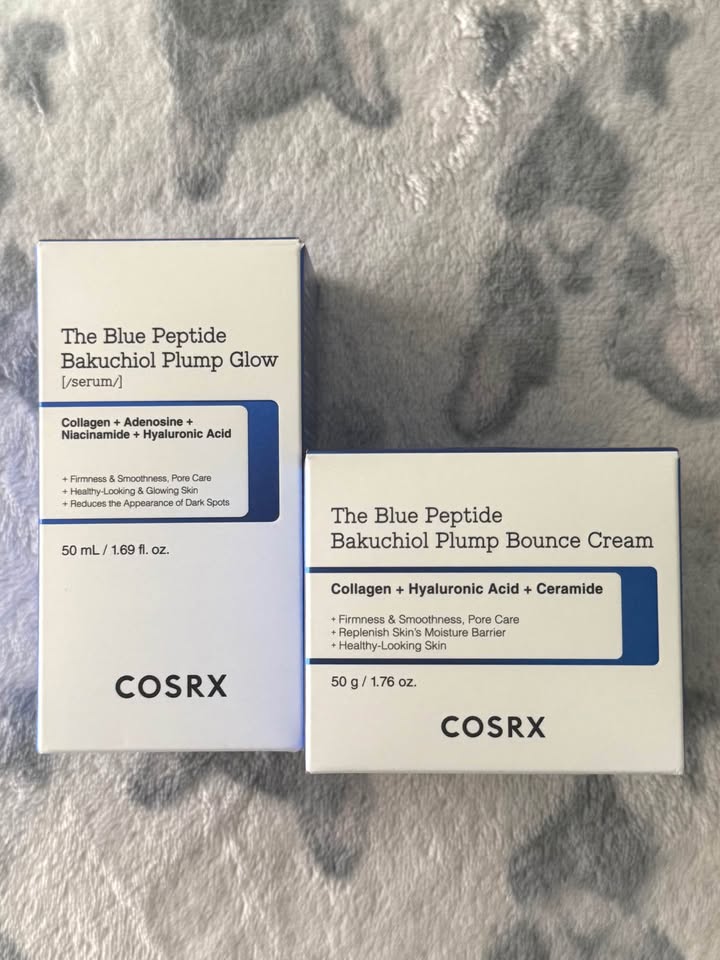
Those are my two actual boxes. Same copper peptide number on both, and that is the whole reason this comparison is worth anything.
What I saw, product by product
With the serum, the higher-bakuchiol one: my skin looked brighter and more radiant within the first couple of weeks, and my dark spots looked lighter to me in that window. That was faster than anything I have experienced from a copper peptide product. Separately and later, firmness, pores and texture improved around weeks four to five. Zero irritation across the eight weeks on sensitive, acne-prone skin. Full notes in my eight-week COSRX serum review.
With the cream, the lower-bakuchiol one: about four weeks of nothing, and then my skin looked fuller, felt firmer, and the texture looked smoother. Zero irritation again. What was not there in the same way was the fast brightening. Full notes in my seven-week COSRX cream review.
Same disclosed copper peptide dose. Five times less bakuchiol. Much less of the fast brightening effect, while the slower firmness and texture changes showed up in both.
Why the copper peptide is the less likely culprit
Two lines of reasoning point the same way.
First, the fast effect does not match what copper peptides are understood to do. The research on GHK-Cu is about firmness, elasticity and overall skin quality accumulating over months. It is a slow, signalling, regenerative story. It is not a pigment story, and nothing about it predicts visibly lighter dark spots in two weeks. When I got an effect the ingredient is not known for, on a timeline it is not known for, the honest move was to ask what else was in the bottle.
Second, the effect does match what bakuchiol is understood to do. Bakuchiol is a plant-derived retinol alternative, and it is the ingredient in these two formulas with the stronger case for tone, radiance and pigmentation. It is also the only variable that differs meaningfully in dose between the two products.
Note also how neatly the split maps onto the two clocks I have seen on every copper peptide product I have run. The week four to six firmness and texture changes appeared in both products, which is exactly what you would expect from the ingredient they share at an identical dose. The two-week brightening appeared in one, which is exactly what you would expect from the ingredient they do not share at an identical dose.
Where this argument is weak
I want to state this plainly rather than let a tidy finding carry more weight than it has earned. This is one person’s experience with two products. It is not a controlled study and it should not be read as one.
Specifically:
- No control, no blinding, no split-face. I used the products sequentially and knew exactly which was which. That is the setup expectation bias thrives in.
- The formats are not comparable. One is a serum, one is a cream. The cream also went on last, over other products, which means it was never a clean test of anything on its own.
- The durations differ. Eight weeks against seven weeks.
- Bakuchiol is not the only difference. These are two different full formulations. The cream carries ceramides and is built around barrier and moisture. Everything outside the two disclosed actives differs too.
- Sample size one. One reactive, breakout-prone face is not a population, and skin varies.
What would settle it is a split-face test with the same base formula and the only variable being the bakuchiol dose. Nobody is running that. So treat what I have as a strong hint that is consistent with the known behaviour of both ingredients, and not as proof.
What it means when you are buying
The practical takeaway is straightforward, and it changes what you should put in the basket.
If you want the glow, look at the bakuchiol number. That is the figure doing the brightening work in this line, and the serum carries five times what the cream does. Buy on that number rather than on the copper peptide marketing.
If you specifically want copper peptides, both give you 0.5%. Identical, disclosed, the correct researched molecule. At that point the choice is simply whether you want a serum or a moisturizer, and the cream is a perfectly good way to get the same copper peptide dose as the last step of a routine. Both sit alongside the pricier options on cost per ml and label disclosure in my master copper peptide comparison.
If you already use a retinoid, the bakuchiol may be redundant. Bakuchiol is positioned as a retinol alternative. If you have a retinoid in your routine already, you are likely paying for an ingredient whose job is being done, and the copper peptide is the part of the formula adding something new.
And prefer the brands that print the numbers. The only reason I could reason about any of this is that COSRX disclosed both figures on both products. With an undisclosed “peptide complex” you cannot even ask the question, let alone answer it.
The broader point
Combination products let one ingredient collect credit for another ingredient’s work. Copper peptides benefit from this more than most, because they are frequently formulated alongside things that act faster and more visibly than they do, and the fast, visible thing is what ends up in the reviews. That is worth knowing before you go and buy a pure, expensive, high-concentration copper peptide serum expecting the glow you read about, and get a slow, quiet, months-long ingredient instead. Which is what it is, and it is still worth using. It is just not what sold you the bottle.
I paid retail for both products in this comparison and used each of them myself, twice daily, for the periods stated. This is an observation, not a study. I have tried to be specific above about exactly what it can and cannot support, and I would rather you discount it correctly than accept it wholesale. How we research.